
It’s no secret that I’m a musician – in fact, a songwriter/producer. I’ve invested late nights bringing my ideas to life, as well as thousands in technology (and Berklee tuition). It was worthwhile because I knew I would, in return, get exclusive rights to my work until I die and for 70 years afterward, among other benefits.
Advanced technology isn’t new to music — shifting from physical soundboards to digital formats, creating new sounds through electronic physics, and sampling. Copyright infringement also isn’t new to music – burning and ripping CDs, and using Napster to download MP3s to iPods and Blackberries. But over the past five years, the creative industries have faced a formidable challenge. Like cutting off a Hydra’s head only for two more to grow back, every time we solve one problem, two new ones emerge. The new challenge: artificial intelligence.
There has been a surge in litigation between copyright and artificial intelligence (“AI”), from private individuals suing companies that utilize AI to large organizations targeting the creators of the technology. In the United States, copyright infringement cases involving AI have been filed numerous times.[1] While OpenAI is often sued for copyright infringement, another company has been involved in actions against record labels and, more recently, GEMA that are far more threatening to the core principles of copyright law.
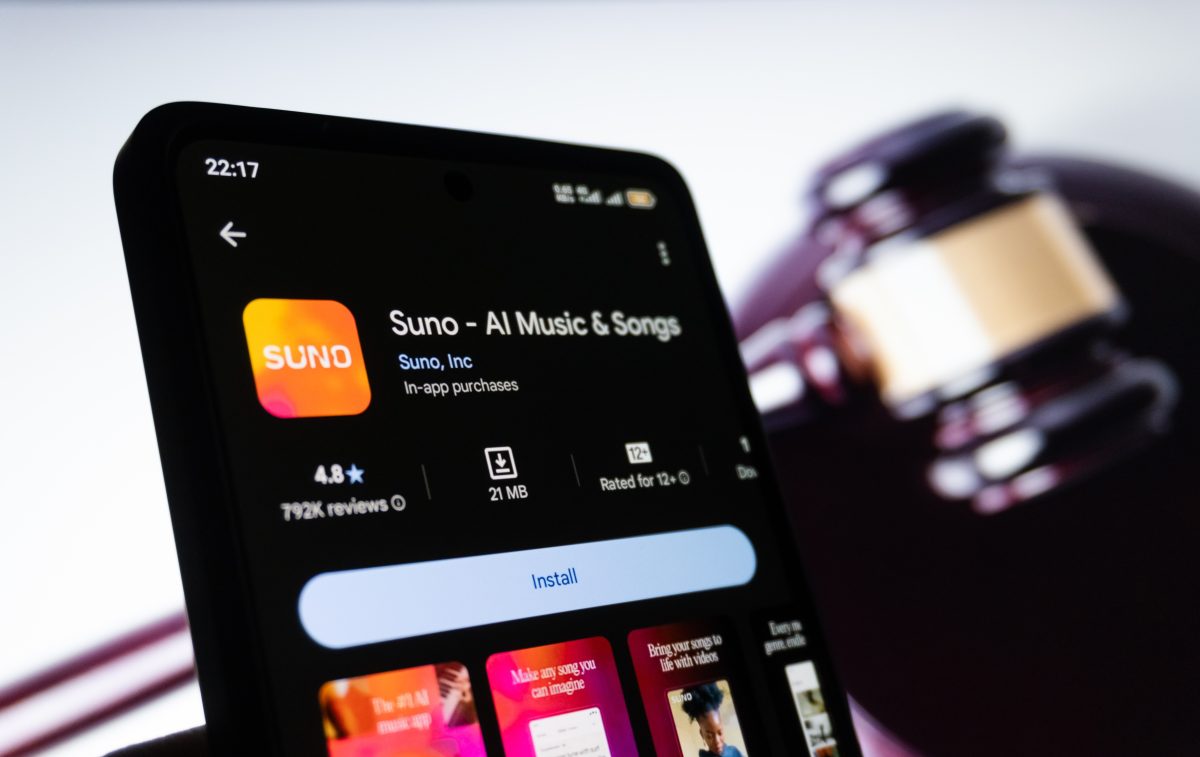
Enter Suno, a generative-AI music creation platform that functions like a digital audio workstation.[2] Widely available since 2023, the platform offers two subscription plans: a free plan, which allows songs to be used for personal, non-commercial purposes but prohibits monetization, and a pro plan, where “songs […] are granted commercial use rights.”[3] The paid subscription also grants rights for streaming platforms, independent distribution, and use in film, television, or video games.[4]
To create, the platform prompts its users to “describe the song [they] want to make”.[5] I prompted it to create a lo-fi dancehall beat with lyrics about facing heartbreak in a club. Within minutes, Suno generated four audio files, ranging from classic reggae without lyrics to a result similar to what I had imagined, including a male voice singing in Jamaican Patois.
This result concerned me. First, Suno could face repercussions for appropriation of voice likeness. Vocalists have distinct styles that add value to their finished products. It’s unlikely that Shaggy’s Mr. Boombastic would be a hit without his iconic rasp. Second, there’s the question of whether the source material for this result was properly licensed. While the copyrights of sound recordings involved in AI misuse cases are usually owned or exclusively licensed by major record companies — likely because they’re songs from mainstream genres by North American artists — the copyrights of songs from smaller genres like dancehall are often owned by the artists, songwriters, their companies, independent labels, or are under exclusive license to small distributors. If Suno did not secure a license from the major record companies, it’s unlikely they would obtain one from smaller labels or artists. This concern probably led GEMA to sue Suno on behalf of its members.
GEMA is one of the world’s oldest collecting societies and performing rights organizations.[6] Collecting societies (CMOs) like GEMA and performing rights organizations (PROs) like ASCAP and BMI play similar but not identical roles in the industry.[7] Whereas PROs manage public performance rights for songwriters and music publishers, CMOs have a broader reach and collectively manage rights beyond public performance.[8]
GEMA filed its copyright infringement suit against Suno on January 21, 2025,[9] and a hearing was held on March 9, 2026.[10] The hearing concluded without a ruling, and a decision is set for June 12, 2026[11]. The case focuses on GEMA’s evidence that Suno’s music tool produces outputs that are “misleadingly similar” to original songs for which it’s responsible.[12] Presenting evidence that Suno-generated content closely matched the original compositions’ musical elements, GEMA claims that Suno used, stored, and reproduced copyrighted recordings of global hit songs to train its AI tool.[13]
Reflecting on the US-based AI platform, GEMA’s general counsel, Dr. Kai Welp, said that “copyright obligations should apply regardless of where AI systems are trained,” aligning with the Berne Convention, which both countries signed.[14] Supervisory Board Chair, Dr. Ralf Weigand, fears an Orwellian future, warning, “we will reach the point where no one [can] make a living from their creative work – a ‘brave new world’ after all human creativity in music has ended!”[15]
Apart from Dr. Weigand’s dystopian predictions, this lawsuit has exposed a part of the open wound that is AI’s impact on the American music industry. Unlike in the European Union, American PROs are not suing AI companies for copyright infringement. Instead, the major record labels, which have previously settled with Suno, are suing the AI companies primarily over misappropriating sound recordings rather than musical compositions.[16] This is because PROs’ jurisdiction covers only the public performance rights of musical compositions, not the other exclusive rights granted by copyright, such as those administered by CMOs.[17] When considering who might have the authority to sue AI companies for copyright infringement of musical compositions, it’s likely the music publishers. However, as songwriters have gained more independence in their musical works, music publishing deals now resemble co-publishing arrangements, in which songwriters retain a share of the copyright, and administration deals, in which the publisher primarily handles licensing opportunities. Still, not all songwriters have publishing deals — most PROs facilitate membership options that allow songwriters to become both writer and publisher members.
While it’s clear that major record companies advocate for sound recordings, there’s little explicit advocacy for musical compositions. In this context, three potential solutions emerge. First, music publishers or organizations can lead efforts to protect musicians’ rights, possibly through broader administration or co-publishing deals. However, songwriters may hesitate to surrender too much control to organizations that aren’t as regulated as PROs. Therefore, songwriters themselves might take the lead in defending their rights, though pursuing infringement lawsuits is costly, and a class-action suit may be unfeasible for individual artists. Third, American PROs may need to consider aligning their models with European CMOs to address AI’s impact on copyright in musical compositions. After all, the music industry was built on a history of accidents, and the U.S.’s primary PROs, ASCAP and BMI, were established during those early days.[18]Still, it’s also possible that the PROs, in coordination with the U.S. Copyright Office, might view Suno’s activities favorably, producing partially generated AI works that are sufficiently original to qualify for copyright protection.[19]With my new lo-fi dancehall beat, I can create something new through sampling that’s sufficiently original to earn copyright protection.
GEMA v. Suno has highlighted that advocacy for the musical compositions themselves is crucial. Should the PROs take on a CMO-like role, should music publishers have more authority to advocate on behalf of their roster, or should artists’ organizations be given more support to fight this battle?
[1] See generally Concord Music Grp., Inc. v. Anthropic PBC, 772 F. Supp. 3d 1131 (N.D. Cal. 2025); Bartz v. Anthropic PBC, 787 F. Supp. 3d 1007 (N.D. Cal. 2025).
[2] Mark Wilson, Suno Explained: How to Use the Viral AI Song Generator for Free, TechRadar (Feb. 14, 2025), https://www.techradar.com/computing/artificial-intelligence/what-is-suno-ai.
[3] What Rights Do I Have with the Free Plan?, Suno: Knowledge Base (last visited Mar. 30, 2026), https://help.suno.com/en/articles/9601601; What Rights Do I Have with a Paid Subscription?, Suno: Knowledge Base (last visited Mar. 30, 2026), https://help.suno.com/en/articles/9601665.
[4] Suno: Knowledge Base, supra note 3.
[5] Suno, https://suno.com (last visited Apr. 2, 2026).
[6] GEMA is the abbreviation for the German translation of “Society for Musical Performing and Mechanical Reproduction Rights”; CISAC, The History of Collective Management, CISAC (2020), https://www.cisac.org/sites/main/files/files/2020-11/CISACUniversity_The_History_of_Collective_Management_FINAL.pdf.
[7] See Performing Rights Organizations (PRO), SongTrust: Music Publishing Glossary, https://www.songtrust.com/music-publishing-glossary/glossary-performing-rights-organization (last visited Apr. 2, 2026); Collective Management Societies (CMO), SongTrust, https://www.songtrust.com/music-publishing-glossary/glossary-collective-management-organization (last visited Apr. 2, 2026).
[8] Andrew Parks, Defining Pay Sources: CMOs vs. PROs, SongTrust (Apr. 25, 2019), https://blog.songtrust.com/pay-sources-difference-between-a-pro-and-cmo.
[9]Murray Stassen, $500M-Valued Suno Hit with New Copyright Lawsuit from Germany’s GEMA, Music Business Worldwide (Jan. 21, 2025), https://www.musicbusinessworldwide.com/500m-valued-suno-hit-with-new-copyright-lawsuit-from-germanys-gema/.
[10]Murray Stassen, GEMA vs. Suno: German Court Hears Landmark AI Music Copyright Case, Music Business Worldwide (Mar. 9, 2026), https://www.musicbusinessworldwide.com/gema-vs-suno-german-court-hears-landmark-ai-music-copyright-case/.
[11] Stassen, supra note 10.
[12] Id.
[13] Id.
[14] Stassen, supra note 10; Members of the Assembly of the Berne Union, WIPO, https://www.wipo.int/wipolex/en/treaties/ShowResults?search_what=B&bo_id=7 (last visited Mar. 30, 2026).
[15] Stassen, supra note 9.
[16] Daniel Tencer, Major Record Companies Sue AI Music Generators Suno, Udio for ‘Mass Infringement’ of Copyright, Music Business Worldwide (June 24, 2024), https://www.musicbusinessworldwide.com/major-record-companies-sue-ai-music-generators-suno-udio-for-mass-infringement-of-copyright/.
[17] Parks, supra note 8.
[18] Bill Colitre, “Music Industry Mavens,” Presentation, Power Players 2026 Symposium, Loyola Law School, Feb. 20, 2026 (“The shape of the music business is the result of a series of historical accidents.”).
[19] Daniel Tencer, Can AI-Generated Content Be Copyrighted? Here’s What a New Report From the US Copyright Office Says…, Music Business Worldwide (Jan. 30, 2025), https://www.musicbusinessworldwide.com/can-ai-generated-content-be-copyrighted-heres-what-a-new-report-from-the-us-copyright-office-says1/; Murray Stassen, ASCAP, BMI and SOCAN Will Now Accept Registrations of ‘Partially’ AI-Generated Musical Works, Music Business Worldwide (Oct. 28, 2025), https://www.musicbusinessworldwide.com/ascap-bmi-and-socan-will-now-accept-registrations-of-partially-ai-generated-musical-works/.