
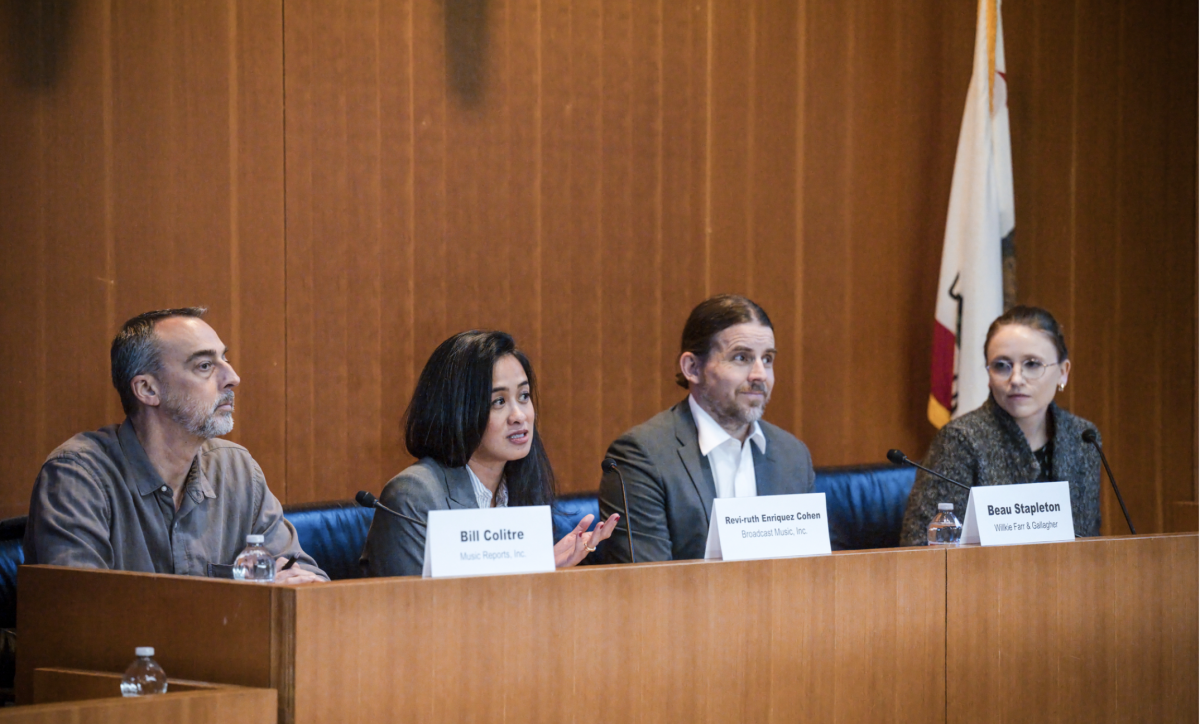
Picture it – 11:00 AM, Friday, February 20, 2026. It’s the penultimate panel at Power Players 2026. The four mavens arrive: Bill Colitre, Chief Operating Officer at Music Reports, Inc.; Revi-Ruth Enriquez Cohen, Vice President of Legal at Broadcast Music, Inc. (BMI); Beau Stapleton, Partner at Willkie Farr & Gallagher; and Caitlyn Miles Kuhs, Vice President of Legal & Business Affairs at Artist Partner Group. Chief Diversity, Equity, and Inclusion Editor for the Loyola of Los Angeles Entertainment Law Review and panel moderator, Vanessa Johnson, opens the panel with one poignant question.
“Who holds the power in the music industry?”[1]The Robinson Courtroom at Loyola Law School became as electrified as a track during an Olympic 100-meter final. The answer seemed simple—mainly rights holders because they control licensing, so platforms can’t distribute music without them. But with transfer and assignment agreements and works made for hire, rights holders aren’t always the creators. Enriquez Cohen stated that creators should hold and be at the moral center of that power, noting, “if it were easy to make music, everyone would do it—but they don’t.”[2] The reality? Creators retain as much power as they’ve kept their share. But what about the rest of the share? Hyperscalers – we’re talking Spotify, Google, ByteDance, can “eat the entire music business for lunch,” says Colitre.[3] However, all is not lost to these companies; they are in a mutual dependency deadlock. Truly, there’s a power law distribution in the music industry: three major labels and their publishers, three dominant digital service providers, and a small tier of superstar artists. This us-against-them structure arises from a ripple effect – in Coitre’s words, “the shape of the music business is the result of a series of historical accidents.”[4] But mapping power was only the beginning. To understand how that power operates, the panelists argued, you must follow the data.
“Copyright law provides the frame, but clean metadata now determines how efficiently [rights’] value is realized,” said Coitre.[5] The panel unanimously agreed that if creators and stakeholders want to advocate for their rights, good data hygiene is key, but only if the music business collectively agrees to respect the intellectual property framework. Metadata is the hidden plumbing of the new music economy – its accuracy is connected directly to royalty accuracy, deal velocity in catalog sales, and investor confidence (if you’re wondering why I’m writing about investors – stick around, you’ll be as shocked as I was). This paradigm’s materiality is transparent in Enriquez Cohen’s response to the topic – she notes that relevant musical data for performing rights organizations has evolved from people listening to radio stations and writing down songs to document them to machines ingesting trillions of lines of streaming data with detailed usage information including duration of play, frequency of play, and the platform on which a song plays.[6] Given the sheer volume and specificity of facts about a song’s performance, the panel stressed that, for rights holders to secure the power they are due, metadata attached to their musical compositions and sound recordings must be accurate.
Remember when I mentioned investors? My bachelor’s degree is in music business, and in my senior year, artists selling their catalogs was all the rage. It made sense – artists selling intellectual property to be more liquid. What I did not expect was what Beau Stapleton said next. Music as a financial asset class.[7] My pen screeched like a vinyl record. And I thought my days of Principles of Accounting from Grenadian secondary school were over.
In finance-speak, an asset class is a category of assets investors buy for a mix of risk and return, including stocks, bonds, real estate, and infrastructure[8]. Over the last decade, music has quietly graduated into that list. Thanks to cleaner metadata and more standardized royalty reporting, catalog income has evolved from a mysterious black box to a series of reasonably predictable cash flows. That shift, Stapleton suggested, really crystallized during the pandemic.[9] While airlines, hotels, and brick‑and‑mortar retail were in freefall, people kept streaming music — in some cases more than ever (especially with the rise of TikTok doomscrolling). As Bill Colitre later framed it, music royalties started to look like a “non-correlated” asset: they don’t rise and fall in perfect sync with the stock market.[10] For large funds under pressure to diversify, that stability is gold. Entire funds now buy up song catalogs and package their future royalties into sophisticated financial products. The contracts that underpin those deals are being rewritten accordingly, with cleaner assignability clauses, tighter registration requirements, and royalty definitions precise enough for a bank to lend against them. In other words, the paperwork around songs is being engineered not just for labels and artists, but for lenders, ratings agencies, and pension funds, even though the underlying value still begins with a composer in a room, trying to write something people will want to hear twice.
After discussing artist deals in the age of virality and expanding on the complexity of the music business due to its accidental foundation, the floor opened for questions. My hand shot up as fast as Usain Bolt crosses a finish line. As you may remember, I penned an article about performance rights organizations accepting registrations of partially AI-generated works[11]. Seeing that I was in the room with the Vice President of Legal at the country’s largest performance rights organization, BMI, I seized the moment, especially as a writer for this esteemed law review. “How has BMI started to deal with registrations of partially AI-generated works?” As I sat, pen in hand for a tech-forward answer, I got “we haven’t, because the policy is not fully implemented yet.”[12] Enriquez Cohen addressed the questions and considerations for adopting this policy: How much AI is acceptable? Is sampling from an AI-generated recording comparable to sampling a human-made track? If a work is partially AI and potentially not copyrightable, should it command the same royalty? The rest of the panel chimed in with their concerns about licensing rates on partially-AI versus fully human creations, and issues with continuity with sampling and compound intellectual property.
At the end of this electrifying discussion, there were several takeaways that, in my absolutely unbiased opinion, made this panel the highlight of this year’s symposium. Power is fragmented, but concentrated. Clean metadata is the future. AI is forcing first-principles thinking: questions of authorship, value, and risk pricing are back on the table, with no consensus yet. Music is now finance-friendly, leading to contracts being rewritten for scale. To the non-believers who said music was just a hobby, who’s laughing now?
The Music Industry Mavens panel aimed not only to discuss current trends in the music business but also to demonstrate its trajectory and how it intersects with other related industries. At this rate, next year, we may be speaking about a musical composition’s ability to lead a country, for all we know.
[1]Vanessa Johnson, “Music Industry Mavens,” Presentation, Power Players 2026 Symposium, Loyola Law School, Feb. 20, 2026.
[2] Revi-Ruth Enriquez Cohen, “Music Industry Mavens,” Presentation, Power Players 2026 Symposium, Loyola Law School, Feb. 20, 2026.
[3]Bill Colitre, “Music Industry Mavens,” Presentation, Power Players 2026 Symposium, Loyola Law School, Feb. 20, 2026.
[4] Id.
[5] Id.
[6] Enriquez Cohen, supra note 2.
[7] Beau Stapleton, “Music Industry Mavens,” Presentation, Power Players 2026 Symposium, Loyola Law School, Feb. 20, 2026.
[8] Akhilesh Ganti, What Are Asset Classes? More Than Just Stocks and Bonds, Investopedia (July 26, 2025), https://www.investopedia.com/terms/a/assetclasses.asp.
[9] Stapleton, supra note 7.
[10] Colitre, supra note 3.
[11] Tiffany Strachan, Songwriting 2.0: Responding to AI-Assisted Musical Compositions, Loyola of Los Angeles Entertainment Law Review: News and Insights (Nov. 25, 2025), https://entertainmentlawreview.lls.edu/songwriting-2-0-responding-to-ai-assisted-musical-compositions/.
[12] Enriquez Cohen, supra note 2.