
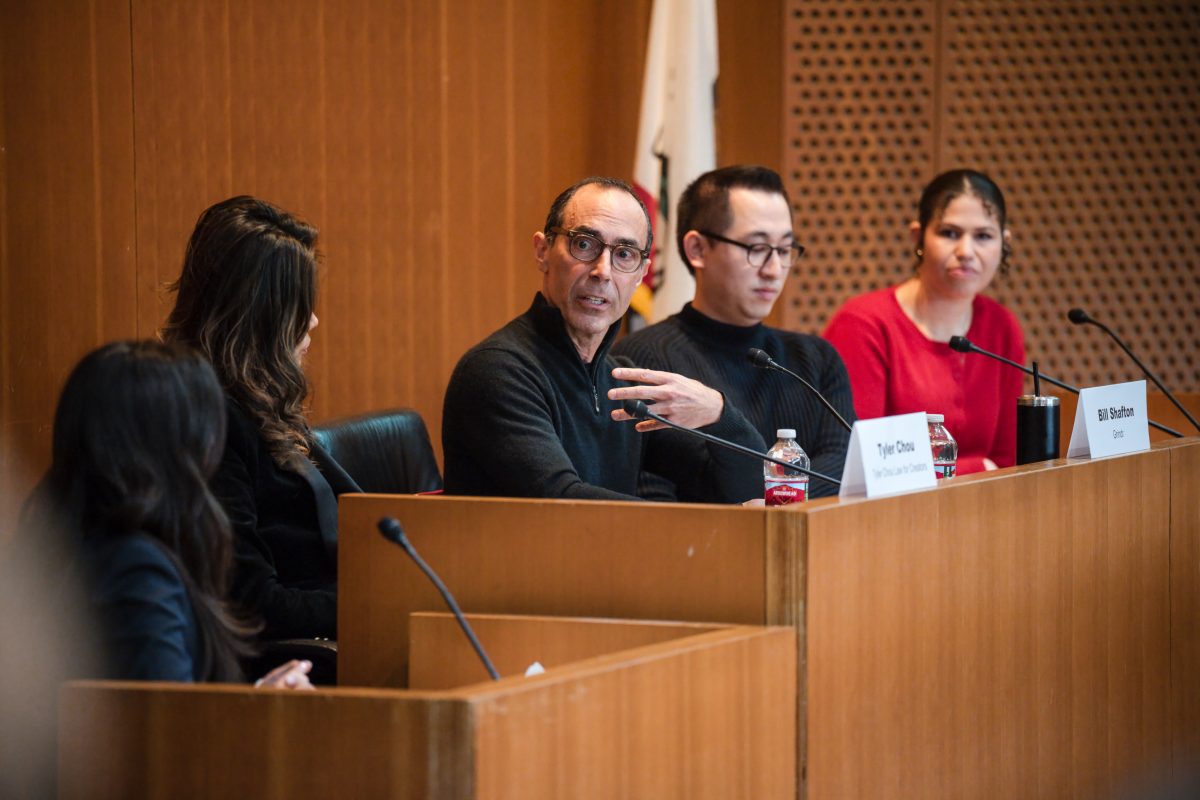
On Friday, February 20, 2026, Loyola Law School’s Entertainment Law Review (“ELR”) hosted its annual symposium, with this year’s theme of “Power Players.” One of the panels, “Content Creator Counsel + Social Media Esquires,” focused on attorneys working at the forefront of the rapidly evolving creator economy. Due to the increasing collaborations between influencers and major companies, the panel’s discussion centered on a specific question shaping modern entertainment law: who holds power in today’s creative ecosystem, and how can our legal structures protect that power?
The panel featured alumni Tyler Chou ‘06, Founder and CEO of Tyler Chou Law, Bill Shafton ‘09, Vice President of Business and Legal Affairs at Grindr, Ted Nguyen ‘16, Partner at Nolan Heimann, and Madi Holtzman ‘24, Legal Counsel for talent at Wasserman. Each speaker offered a unique perspective regarding creator representation, platform regulation, brand partnerships, and agency practice. Together, their different niches create a unique array of perspectives in an industry undergoing high-speed evolution—where contracts, intellectual property ownership, and compliance are becoming just as pertinent as creativity and audience reach.
The panel opened with a discussion of who truly holds power among creators, platforms, brands, and intermediaries. Chou emphasized that many creators misunderstand their position within the ecosystem: “Most creators don’t realize that they’re just tenants to YouTube and Meta – you don’t own that land. And if you don’t own the audience, you don’t own the data. If you lose your channel tomorrow, you lost everything.”[1] Here, Chou stressed the importance of creators understanding their rights and going through the necessary processes to retain those rights. She noted that even among highly successful creators, basic ownership infrastructure is often missing.[2] Here, it would become the attorney’s job to guide that power for these creators because they don’t understand the potential of their own reach and the consequences of mismanagement.[3]
At the same time, the panelists agreed that power dynamics have shifted significantly over the past decade. Shafton reflected on how influencer legitimacy has evolved within the legal profession itself: “Back in 2016 when I was at a boutique entertainment firm, I was just starting off and wanted to bring in an influencer client with seven million followers, and the partners were like, ‘What does she do?’”[4] Today, within these 10 years, so much has changed. Now, creators often have agents, lawyers, and managers advocating for their interests, with brands increasingly recognizing their own negotiation leverage as “the party that holds the leverage is the party that needs the deal the least,” Shafton explained.[5] He further explains that “the creator owns the authenticity, the voice, the cache. The platforms have the hold on the data that flows, and the brands are the sponsors of the campaign and controls where the money flows,” and these notions help consumers and creatives alike to understand the ecosystem as a balance of different forms of control.[6]
Another portion of the discussion involved early-stage legal vulnerabilities that later become major disputes. Chou described a recurring pattern in creator businesses that often leads to trouble. These situations, often referred to as “friends and family handshake deals,” are informal and undocumented arrangements with friends or family that later tend to create ownership conflicts.[7] Chou further notes that these situations become particularly problematic when success changes expectations. Because of this, she emphasizes the importance of addressing legal structure early, even when relationships feel stable.[8] “Creators are the new Hollywood. They are start-ups. They are media companies,” Chou asserts, insinuating that business structures parallel to those of traditional media companies are now necessary safeguards.[9] The broader takeaway here is clear: always have a contract in place, even with friends and family.
As the creator economy matures, Holtzman describes agency representation as both protective and collaborative. Here, the focus would be to help clients build the brand they envision for themselves and protect them from exploitation at the hands of large companies.[10] Holtzman highlighted a shift towards more standardized contract language as digital content creation becomes a cultural staple, a development that provides creators with greater control even as brands continue to retain significant bargaining power.[11] Shifting the focus to his own practice, Nguyen highlighted how his background in visual storytelling shapes his approach to drafting and negotiating contracts, as understanding production environments has allowed him to anticipate certain risks during negotiations.[12] Due to Nguyen’s multidisciplinary background, he’s able to foresee circumstances that would normally go over one’s head, giving him important foresight. Likewise, this same familiarity with production dynamics allows room for empathy, helping him connect to his clients on a personal level.[13] “Creators are survivors. They really are truly artists, and there’s a lot of emotion behind what they create,” Nguyen explains.[14]
The discussion also addressed emerging legal threats to the creator ecosystem. Nguyen expressed concern about Federal Trade Commission (“FTC”) endorsement regulations and inconsistent trends.[15] “What I’m seeing is state-by-state FTC rules where individual plaintiffs can sue,” he explained, noting that influencers could potentially face large-scale liability for certain inadequate disclosures.[16] Artificial intelligence (“AI”) poses another major risk. Chou discussed how generative technology is increasingly capable of replicating a creator’s likeness.[17] Today, AI can obtain a creator’s video and digitally replace the original face with another, what some people are referring to as “skinning,” she explains.[18] Because regulation remains uncertain, Chou encourages creators to first focus on protecting and owning their intellectual property through copyright and trademark protection to avoid such circumstances.[19]
The panel demonstrated how the creator ecosystem is evolving into a sophisticated industry where contracts, intellectual property rights, and regulatory compliance shape outcomes just as much as the creative aspect itself. While creators generate cultural influence, the attorneys guide ownership, leverage, and protection. As the industry continues to grow, attorneys will play an increasingly central role in creating new law, helping creators move from platform dependency into long-term ownership. Through such endeavors, the law can ensure success supported by legal foundations.
[1] Tyler Chou, “Content Creator Counsel + Social Media Esquires,” Power Players, Loyola Law School, Feb. 20, 2026.
[2] Id.
[3] Id.
[4] Bill Shafton, “Content Creator Counsel + Social Media Esquires,” Power Players, Loyola Law School, Feb. 20, 2026.
[5] Id.
[6] Id.
[7] Chou, supra note 1.
[8] Id.
[9] Id.
[10] Madi Holtzman, “Content Creator Counsel + Social Media Esquires,” Power Players, Loyola Law School, Feb. 20, 2026.
[11] Id.
[12] Ted Nguyen, “Content Creator Counsel + Social Media Esquires,” Power Players, Loyola Law School, Feb. 20, 2026.
[13] Id.
[14] Id.
[15] Id.
[16] Id.
[17] Chou, supra note 1.
[18] Id.
[19] Id.