
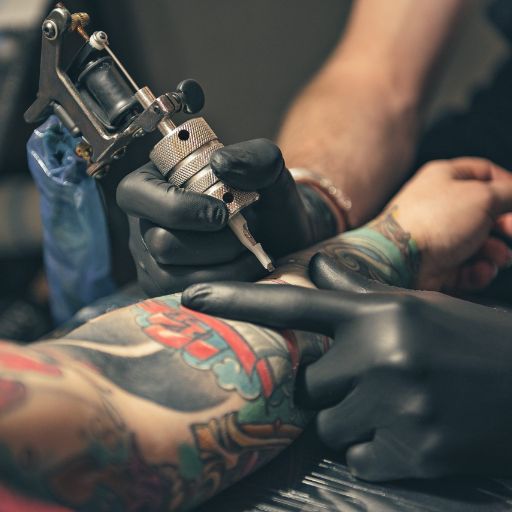
Image used under license from Shutterstock.com.
This is an amended version of the article originally published on March 1, 2024. Changes have been made to update the content for accuracy and clarity.
Photographer Jeffery Sedlik has filed an appeal to the Ninth Circuit Appellate Court asking that they reverse the District Court jury’s finding that a tattoo by Kat Von D was not substantially similar to his photograph of Miles Davis.[1] On January 26, 2024, a jury in the Central District of California held that the famous tattoo artist Kat Von D did not violate US copyright law when she gifted her friend Blake Farmer a tattoo of Miles Davis.[2] On May 3, 2024 District Court denied Sedlik’s renewed motion for judgment as a matter of law and motion for a new trial, leaving in place the jury’s finding that Von D’s tattoo depicting Miles Davis is not substantially similar to Sedlik’s copyrighted photo of Miles Davis.[3]
Jeffery Sedlik, also an adjunct professor at the ArtCenter College of Design and head of the nonprofit Plus Coalition, captured and owns a valid copyright for the Miles Davis image the tattoo was based upon.[4] He filed a copyright infringement claim in February 2021 against Von D for her unauthorized use of his photo in both her work and her social media content showcasing the application of the tattoo on Farmer.[5] Von D denied that her use was infringement, claiming an affirmative defense that the tattoo was a fair use of the original photo.[6] Both parties moved for summary judgement, which the District Court judge denied in favor of a jury’s analysis of whether the tattoo violated copyright law.[7]
To determine whether summary judgement was proper for either party, the court weighed the fair use factors: 1. The purpose and nature of the defendant’s work, 2. The nature of the plaintiff’s work, 3. The amount and substantiality of the original work that the defendant used, and 4. The potential market effect of the defendant’s use on the plaintiff’s ability to exploit their work.[8] Often in determining the purpose and nature of the defendant’s work, courts will use the transformative use test which asks if the new work significantly altered the nature of the original work.[9]
The court considered the transformative use test and determined that Sedlik successfully showed that the tattoo was not transformative.[10] However, the court determined that the first factor of fair use could not be decided as a matter of law.[11] The court went on to say that there is a material factual issue present as to whether the tattoo was a commercial use of the photo because the social media uses may be considered incidental and the tattoo was given free of charge.[12] The judge found triable issues under the first and fourth fair use factors, resulting in the denial of both side’s motions for summary judgement.[13]
Ultimately, the jury deliberated on whether the tattoo infringed upon Sedlik’s photograph.[14] To have a successful claim of copyright infringement, two elements must exist: 1. The original work has a valid copyright owned by the plaintiff and 2. The defendant improperly copied the plaintiff’s protected work.[15] Sedlik had a valid copyright on his original photo of Miles Davis; therefore, the jury was left to decide what elements of the photo are protectable by the copyright and if those elements were improperly copied by Von D.[16] The jury looked at whether the tattoo was substantially similar to Sedlik’s photo to decide whether improper copying existed.[17]
Remarkably, the jury reached their conclusion in the span of two to three hours, determining that the tattoo was not substantially similar to Sedlik’s photo.[18] The jury’s decision means that there was no prima facie case for copyright infringement. Further, the opposing sides interpret the short time frame of the jury’s deliberations to mean different things. Sedlik’s lawyers urge that the decision was rushed, and more time and consideration are needed to reach an accurate result.[19] They stated to reporters, “The photo and the tattoo are so strikingly similar. And if those two are not substantially similar, then no one’s visual art is safe.”[20] Conversely, Von D’s lawyers are insistent that the short time frame is a sign that the case never should have come to trial in the first place.[21]
Sedlik’s now asks the Appellate Court to review the issue of substantial similarity and whether Von D met her burden in demonstrating that her tattoo was a fair use of Sedlik’s photograph.[22] Additionally, Sedlik’s appellate brief raises two procedural issues: 1. whether the jury’s instructions were correct and 2. if exclusion of Sedlik’s own expert testimony on his practices and the photography industry was proper.[23]
As it stands, this case will only have persuasive, not mandatory, authority over any future cases because it was decided by the District Court. However, should this case progress through the Ninth Circuit court system, artists and those who work alongside them will want to keep an eye on how this case is decided and the impact those decisions may have on their ability to license their art.
[1] Appellant’s Opening Brief, Sedlik v. Von Drachenberg, No. 24-3367 (9th Cir. Oct. 15, 2024).
[2] Chloe Briggs, Of Ink and Cool Jazz: California Jury Finds For Defendants in Copyright Infringement Case, MSK (Jan. 31, 2024), https://www.msk.com/newsroom-alerts-client-alert-tattoo-copyright-infringement.
[3] https://www.loeb.com/en/insights/publications/2024/05/sedlik-v-von-drachenberg#:~:text=Von%20Drachenberg,-Safia%20Hussain&text=District%20court%20upholds%20jury%20verdict,and%20request%20for%20new%20trial.
[4] Adam Lidgett, Photog Tells 9th Circ. Miles Davis Tattoo Was Not Fair Use, Law 360 (Oct. 16, 2024, 8:44 PM), https://www.law360.com/washington/articles/1890666/photog-tells-9th-circ-miles-davis-tattoo-was-not-fair-use.
[5] Id.
[6] Id.
[7] Sedlik v. Drachenberg, No. CV 21-1102 DSF (MRWx), 2023 U.S. Dist. LEXIS 183184 (C.D. Cal. Oct. 10, 2023).
[8] Id.
[9] Transformative Use and Copyright Infringement Lawsuits, Justia, https://www.justia.com/intellectual-property/copyright/fair-use/transformative-use/
[10] Supra, note 4.
[11] Id.
[12] Id.
[13] Id.
[14] Supra, note 1.
[15] 17 U.S.C. § 501(a)-(b).
[16] Kate Lucas, A Photograph, A Tattoo, and a Lawsuit: Copyright Infringement Case Clears Summary Judgment, Heads Toward Trial, Grossman LLP (July 20, 2022), https://www.grossmanllp.com/A-Photograph-A-Tattoo-and-a-Lawsuit.
[17] Supra, note 1.
[18] Sopan Deb, Kat Von D Wins Copyright Trial Over Miles Davis Tattoo, NY Times (Jan. 31, 2024), https://www.nytimes.com/2024/01/27/arts/kat-von-d-miles-davis-tattoo-copyright-trial.html.
[19] Maia Spoto, Kat Von D Wins Copyright Case Over Miles Davis Photo (Correct), Bloomberg Law (Feb. 16, 2024), https://news.bloomberglaw.com/litigation/kat-von-d-tattoo-of-miles-davis-isnt-infringement-jury-rules.
[20] Id.
[21] Supra, note 14.
[22] See note 1.
[23] Id.