
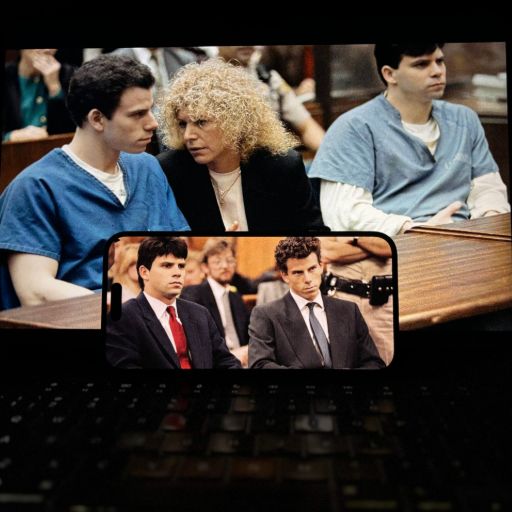
Image used under license from Shutterstock.com.
Erik and Lyle Menendez are two criminal brothers who have become nothing less than celebrities since their convictions.[1] In 1996, Erik and Lyle were convicted of first-degree murder for the brutal killing of their parents, Jose and Kitty Menendez.[2] Their trials were broadcast for the world to see and it didn’t take much time for their fame to take off with broad recognition and copious media attention.[3] Interestingly, they are more famous today and this increased public awareness may help in their resentencing scheduled to take place on January 30th of next year.[4] Yet, there is fury around the protection of their name and identity, and it is deeper than many think. The recent premiere of the Netflix documentary and docu-series, “The Menendez Brothers” and “Monsters: The Lyle and Erik Story,” may complicate it even further. In the Netflix documentary, Menendez family members protested the usage of their identity and their name on Saturday Night Live and the Jay Leno Show around the time of the trials. The response was to no avail: “They are public property now,” said Leno producers.[5]
Thirty years of media attention may impact their resentencing trials for better or for worse. Challenging indeed: Can these new celebrities protect their name and identity like all other Hollywood-famers or is public policy against famous criminals?
In 1996, the Menendez brothers were convicted in their second trial for the murder of their parents who were shot and killed at close range in their Beverly Hills Mansion in 1989.[6] Immediately after the murder, Erik and Lyle were quick to invest their inheritance in Rolex watches and real estate, and did not appear to experience the usual grief and sadness following the death of a close family member.[7] Eventually, the unfazed brothers were arrested for first-degree murder after Erik, the younger of the two, confessed the brothers’ crime to his psychologist.[8] The psychologist shared the confession with his indiscreet girlfriend who later informed the police.[9] The brothers’ separate and first trials were publicly broadcast, which led to the brothers’ instant fame and a hung jury.[10] After a formal confession and another trial, the brothers were arrested for first-degree murder and focus soon turned to why they gruesomely killed their parents.[11] Both brothers claimed to have been acting in self-defense after years of physical, emotional, and sexual abuse by their Hollywood-executive-father, while their mother allegedly stood idly by as the abuse was taking place.[12]
After almost 30 years from their formal convictions and blasted media attention on TV and social media, their case is back in the news. Last month, newly-ousted Los Angeles District Attorney, George Gascon, advocated for resentencing that led to the now postponed trial date of January 30, 2025.[13] Recent social justice movements have expressed deep sympathy and compassion for sexual abuse victims, which has helped humanize the Menendez brothers’ case and supported the call for resentencing.[14] True crime “reinvestigations” of murder cases have brightened the spotlight even more for the Menendez case.[15] It is without a doubt that media attention impacts jury decision-making, even with an oath sworn for impartiality.[16] Even with the intention to be impartial in jury decision-making, public narrative and bias may interpret evidence reading and analysis.[17] Therefore, it is understandable that the Menendez brothers would want to regulate the use of their identity as high-profile criminals since the media attention is likely to impact the outcome of their upcoming resentencing trials. Yet, even with statute-protected “celebrity” status, the brothers’ control over the intellectual property of their name and character is slim to none because their story as high-profile murderers is of public interest.
A celebrity is defined as one with “personal fame or renown as manifested in (determined by) public interest and media attention” and with this constant attention, celebrities are offered intellectual property protection.[18] The Celebrity Rights Act, codified as California Code Civ §3344, protects the identity and unauthorized usage of “another’s name, voice, signature, photograph, or likeness, in any manner ….” [19] In essence, the Act protects a celebrity in the economic value of their personhood, for example, their personal brand and potential.[20] It should be of no surprise that the identity of a celebrity can be worth millions of dollars and, therefore, the identity should only be capitalized by the celebrity themself. Through this analysis alone, it would only make sense for the Menendez brothers to receive this protection. Unfortunately, the use of a criminal’s name and identity is coupled with the First Amendment defense and obstruent public policy.[21]
The First Amendment defense protects certain speech or expression that is “newsworthy,” containing factual and news information related to public issues, even when an “unauthorized” and generally protected use of a celebrity’s likeness is used in a broadcast.[22] Public policy also suggests that criminals who acquire fame and, therefore, are provided full protection to exclusively capitalize their intellectual property rights may send the wrong message to potential criminals: criminal activity is inadvertently encouraged if the criminal can exclusively profit off his or her identity.[23] Thus, criminal activity can be capitalized “by way of movies, books, television shows, or any other source that is derived from any depiction of the criminal’s activities.”[24] Not to mention, providing criminals exclusive protection of their intellectual property rights would also violate the First Amendment right defense, disengaging the value of “newsworthiness” by prohibiting the broadcast of public criminal cases that are of great interest to the general public.[25]
The Menendez brothers’ case takes on increasing media attention with the Netflix premieres and news reports of their January 30th resentencing trial. The brothers may continue their protest for the protection of their intellectual property rights to ensure a fair and impartial jury. However, the infamous brothers are unlikely to succeed and may not be afforded the statutory protections enjoyed by celebrities.
[1] Alicia Victoria Lozano, Did Hollywood help the Menendez brothers’ case?, NBC News (Oct. 26, 2024), https://www.nbcnews.com/news/hollywood-help-menendez-brothers-case-rcna177372#.
[2] Olivia B. Waxman, The Menendez Brothers Are Back in the Spotlight. Here’s What to Read and Watch to Understand Their Case, TIME Magazine (Sept. 24, 2024), https://time.com/7023814/menendez-brothers-guide-stories/.
[3] Lozano, supra note 1.
[4] Zoe Sottile, Judge delays resentencing hearing for Menendez brothers, CNN (Nov. 25, 2024), https://www.cnn.com/2024/11/25/us/erik-lyle-menendez-brothers-status-hearing/index.html.
[5] The Menendez Brothers (Netflix Oct. 7, 2024).
[6] Alicia Tejada, Inside the story of the notorious Menendez brothers case, CBS News (Oct. 24, 2024), https://www.cbsnews.com/news/menendez-brothers-inside-the-notorious-case-48-hours/.
[7] Id.
[8] Id.
[9] Id.
[10] Courtney McGinley, Menendez Brothers’ Trial Juror Breaks Silence: ‘Battle Of The Sexes’, Newsweek (Nov. 15, 2024), https://www.newsweek.com/menendez-brothers-lyle-erik-trial-juror-hazel-thornton-1986529.
[11] Tejada, supra note 6.
[12] Id.
[13] Sottile, supra note 4.
[14] Eric Levenson, A timeline of the Menendez brothers’ murder case and the push to reexamine it, CNN News (Oct. 6, 2024), https://www.cnn.com/2024/10/06/us/menendez-brothers-timeline/index.html.
[15] Jeanine Santucci, Case closed? True crime shows keep affecting real cases, including Menendez brothers., USA Today News (Oct. 26, 2024), https://www.usatoday.com/story/news/nation/2024/10/26/menendez-brothers-case-and-true-crime/75838940007/.
[16] The Power of Media Coverage: How it Shapes Jurors’ Perceptions and How Scientific Jury Analysis Can Help Mitigate Bias, Jury Analyst, BLOG (May 19, 2023), https://juryanalyst.com/blog/the-power-of-media-coverage-how-it-shapes-jurors-perceptions-and-how-scientific-jury-analysis-can-help-mitigate-bias/#:~:text=Priming%20Effects:%20Priming%20refers%20to,to%20distorted%20interpretations%20of%20evidence..
[17] T. Kirk Truslow, How Social Media Impacts Criminal Cases, T. Kirk Truslow, P.A., BLOG (June 30, 2024), https://www.attorneytruslow.com/blog/2024/june/how-social-media-impacts-criminal-cases/.
[18] Oxford English Dictionary (online ed. 2016), celebrity, https://www.oed.com/dictionary/celebrity_n?tl=true; Cal. Civ. Code § 3344 (West).
[19] Id.
[20] Michael J. Hoisington, Celebrities Sue Over Unauthorized Use of Identity, Higgs, Fletcher, and Mack, https://higgslaw.com/celebrities-sue-over-unauthorized-use-of-identity/ (last visited Nov. 27, 2024).
[21] Id.; Stephen Reginald Fowler, Taking a Bite Out of Michael Vick’s Publicity Rights: An Analysis of How the RIghtRight of Publicity Should be Treated After a Celebrity is Convicted of a Crime, 16 UGA. INTELL. PROP. 111, 125-128 (Oct. 2008).
[22] Hoisington, supra note 20.
[23] Fowler, supra note 21.
[24] Id.
[25] Id.