
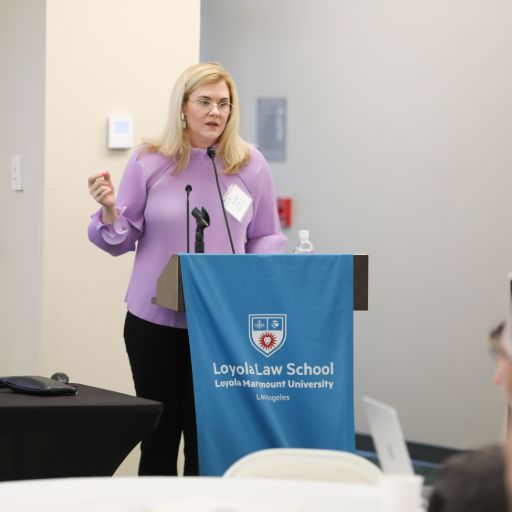
On Friday, February 28, 2025, Loyola Law School’s Entertainment Law Review hosted its annual symposium on AI in the Entertainment Field, namely, AI-use regarding music streaming royalties, talent deals including AI-related clauses in film and tv, and AI usage within the sports industry. This years’ keynote speaker, Natalie LeVeck, Senior Legal Counsel at Google ended the evening with a thoughtful lecture on fame in the age of artificial intelligence (hereinafter, “AI”) and the associated legal and social ramifications legal professionals should consider as AI infiltrates every aspect of our social lives.
LeVeck particularly refers to the progressive use of celebrity-likeness through generative AI for endorsement, advertising, or other marketing-related purposes. [1] Generative AI refers to deep-learning models that can generate high-quality text, images, and other content based on the data they were trained on.[2] The problem or warning to consider is when generative AI is used to create hyper-realistic images and audio snippets of our favorite celebrities that amplify hate speech and misinformation. [3]
With the rampant involuntary use of celebrity-likeness ownership of one’s likeness and legal protection remains indeterminate. [4] LeVeck affirms that the answers to these legal questions will ultimately define the future of entertainment, digital rights, and personal identity, altogether.[5]
This phenomenon of using a person’s likeness without their consent to deceive others has been coined as “deepfake” AI technology. [6] “Deepfakes” are considered media content (images, holograms, videos, audio recordings, etc.,) created by AI technologies that are generated by machine-learning algorithms combined with facial-mapping software that can insert that data into digital content without permission.[7] When execution of this type of content is identical to the original it makes it nearly impossible to ascertain whether the messages are fabricated.[8]
At the center of this discourse includes the legal right of publicity. [9] The right of publicity protects a personality’s name, image, voice, signature, and likeness.[10] In order to establish a cause of action for a right of publicity violation, a plaintiff must show: (1) the validity of the plaintiff’s right of publicity, and (2) that this right has been infringed upon by the defendant.[11] However, the caveat of this analysis requires there be an element of commercial use. While this legal cause of action falls short as an adequate remedy for the misuse of a celebrities’ likeness when no commercial use is found, there isn’t any regulatory tool to fill in the legal gap. [12]
Some U.S. Senators have proposed the use of the DEFIANCE Act (the “Act”) to punish those who create AI deepfakes to spread nonconsensual pornography. [13] The Act would guarantee federal protections for those impacted by granting the right to take civil action against individuals who knowingly produce, distribute, or receive nonconsensual sexually explicit digital forgeries.[14] Can the scope of this Act be extended or broadened to bridge the legal gaps aforementioned?
Discussions surrounding ownership of AI-generated performances also remain underdeveloped. [15] LeVeck points out that the industry is grappling with whether use of AI models to train on an actor’s past films or music should be considered fair use or copyright infringement. [16]What we know is that copyright law only protects human generated works. [17] So, what’s the answer?
Even without federal guidelines, the entertainment industry is responding on its own. [18] For example, YouTube, a popular video sharing platform, implemented new changes to its user policies which include new disclosure rules, a streamlined takedown process, and has spearheaded a new content authenticity initiative. [19] In addition, Guild Agreements now include elements of AI protections. [20] For example, the Writers Guild Association (“WGA”) requires that studios obtain a writer’s consent when generating scripts or re-writing a human-written script. [21] The Screen Actors Guild – American Federation of Television and Radio Artists (“SAG AFTRA”) also requires that studios acquire consent before creating digital replicas of actors. [22]
LeVeck predicts that within the next few years celebrities and society will continue to embrace AI if not merely for the spectacle. [23] While federal enforcement and regulation of AI remains rudimentary, we may start to see stricter enforcement within the next five years with tech companies remaining in the “hot seat;” otherwise, “AI will set the rules for all of us.” [24] LeVeck cautions, “will we control AI or will AI control us.”[25]
[1] Natalie LeVeck. “Fame in the Age of Al: The Promise and Perils of Generative Technology for Celebrities,” Presentation, From Precedent to Algorithm: Navigating AI, Law, and the New Entertainment Frontier, Loyola Law School, February 28, 2025, (0:03:02 – 0:06:06), [https://lmu.app.box.com/s/h51r2g7i499v4c7wfdfiywim3m4ivkyi].
[2] Kim Martineau, What is Generative AI?, IBM, https://research.ibm.com/blog/what-is-generative-AI (Last Visited March 26, 2025).
[3] LeVeck, supra note1at 0:15:49.
[4] Id at 0:08:47.
[5] Id at 0:10:03.
[6] Sara H. Jodka, Manipulating reality: the intersection of deepfakes and the law, Reuters, https://www.reuters.com/legal/legalindustry/manipulating-reality-intersection-deepfakes-law-2024-02-01/ (Last Visited March 26, 2025).
[7] The Rise of Artificial Intelligence and Deepfakes, Northwestern Buffett Institute for Global Affairs, https://buffett.northwestern.edu/documents/buffett-brief_the-rise-of-ai-and-deepfake-technology.pdf (Last Visited March 26, 2025).
[8] Id.
[9] LeVeck, supra note1at 0:10:24.
[10]Mark Roesler and Garrett Hutchinson, What’s in a Name, Likeness, and Image? The Case for a Federal Right of Publicity Law, American Bar Association, https://www.americanbar.org/groups/intellectual_property_law/resources/landslide/archive/whats-name-likeness-image-case-federal-right-publicity-law/ (Last Visited March 26, 2025).
[11] Id.
[12] LeVeck, supra note1at 0:10:33.
[13] Id at 12:28
[14] Press Release, Alexandra Ocasio-Cortez, Passage of the Defiance Act (July 23, 2024), https://ocasio-cortez.house.gov/media/press-releases/ocasio-cortez-statement-senate-passage-defiance-act#:~:text=The%20DEFIANCE%20Act%20would%20guarantee,nonconsensual%20sexually%2Dexplicit%20digital%20forgeries (Last Visited March 26, 2025).
[15] LeVeck, supra note1at 0:9:09; 0:18:48.
[16] Id at 0:19:03.
[17] Id at 0:19:33.
[18] Id at 0:21:29.
[23] Id at 0:42:03.
[25] Id at 0:51:03.